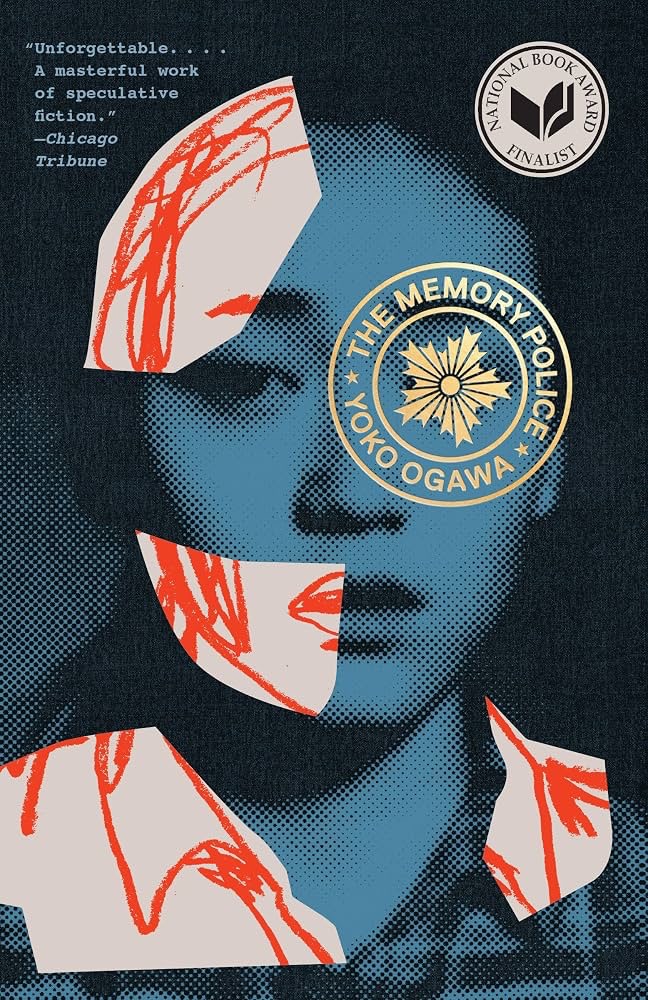
The novel is set on an island. People work, eat, visit each other, fall ill, and grow old. Yet, things disappear. They are not misplaced or lost. They are disappeared. When this happens, most inhabitants lose not only the object but also their emotional ties to it. They forget what the object was and what it once meant. Birds disappear. Photographs disappear. Soon calendars, fruit, novels, and more follow. Ogawa doesn’t explain why. This withholding creates an immediate sense of menace. We don’t know who decides what disappears, why one thing goes and another stays, or whether anyone decides at all.
The Memory Police enforce these disappearances, but they appear to be part of a bigger, stranger system.
One of the questions the narrator poses is how the Memory Police notices those who can’t forget. These people look like everyone else. The narrator wonders why they can’t just pretend. Why not get rid of the vanished objects, say the right things, and act normally? Her editor, R, one of those who remembers, suggests pretending might be impossible. He says consciousness is just a small part of the mind. Something deeper reveals their true nature. Remembering isn’t just stored information in the brain. It lives within the person. The Memory Police aren’t just managing people. They are also managing an internal state.
Later, the unnamed narrator, who is a novelist, asks another simple question: “And what will happen if words disappear?” That question changes the scale of the novel. Before this, the disappearances seem like events happening around her. Something vanishes, and she adapts. She loses objects, connections, and memories. But words are unique. For a novelist, words aren’t just tools. They shape how the world is understood and rebuilt.
Ogawa adds depth with a clever structural device. Some chapters start with scenes that seem part of the narrator’s life. In one scene, she climbs a narrow staircase that reminds her of a lighthouse from her childhood. After several pages, we realise we’ve entered the novel she is writing. A new world unfolds within another. Later, when novels disappear, this structure gains a deep significance. The narrator doesn’t just lose books. She loses access to the part of herself that can write them.
One of the most beautiful disappearances is that of the roses. The narrator hears strange sounds outside and looks through the window. The river is now covered in colour. Red, white, and pink, slivers drift together on its surface. She goes downstairs, reaches into the water, and lifts her hands. Her palms are filled with rose petals. For a brief moment, disappearance feels abundant. The river is full, and vibrant colours surround her. The roses are at their most beautiful, even as their meaning fades. Soon, they will hold no meaning at all.
When R asks the narrator whether she wants to recover her forgotten memories, the narrator struggles to answer. How can she desire something she no longer understands? We often think of forgetting as something we can easily recognise. I have forgotten something. But Ogawa presents a deeper idea. What if the awareness of loss fades away too?
Inevitably, parts of the body disappear. Seen alone, each loss blends into daily life. But together, they create a devastation. Forgetting turns into a skill. Like any skill, it gets easier with practice. Because things don’t just vanish into thin air. The inhabitants throw them away after they are disappeared. They destroy them, release them into the river, or burn them. The disappearance starts within the person. Then the physical destruction follows. Most people feel no emotional link to what has vanished. So, destroying it seems the next natural step. The Memory Police are still needed because some people remember. People like R are dangerous because they remember and because of this they can maintain connections. They know the present world isn’t the only one that has existed. They remember alternatives.


 The Convergence Project
Leave a comment