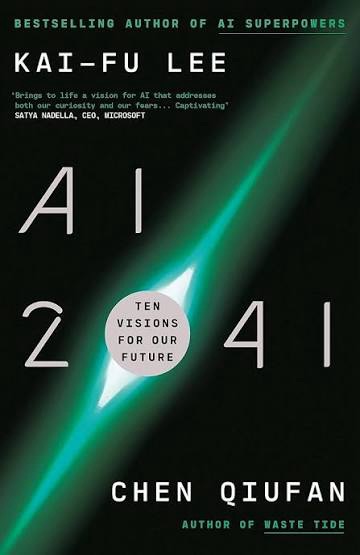
AI 2041: Ten Visions for Our Future is a unique book that combines two ways of imagining the future. Written by AI expert Kai-Fu Lee and speculative fiction writer Chen Qiufan, it includes ten short stories along with explanations. The authors aim to answer a key question: How will artificial intelligence change our world over the next twenty years?
Each story takes place in 2041 and explores how AI may impact our lives. The futures they depict are creative yet feel close to reality. They rely on current technologies and explore what might happen as these technologies become more powerful and more integrated into society.
I will focus on the second story, “Gods Behind the Masks,” set in Lagos, Nigeria. It follows Amaka, a young video producer skilled in creating deepfakes. He faces pressure to produce an undetectable fake video for political use. What starts as a tale of technological deception evolves into an exploration of identity, surveillance, and power. It questions what happens to truth when any face, voice, or event can be convincingly created.
Gods Behind the Masks starts in a high-tech, near-future Lagos. Amaka dodges his train fare by wearing a 3D-printed mask. This mask confuses the station’s facial-recognition system. Among the city’s youth, these masks are now common. Items that once had ritual meaning for older generations are now used for fashion and to evade surveillance. From the start, the story combines tradition with technology. The mask carries the history of one world while helping Amaka survive in another.
In Gods Behind the Masks, Lagos is the biggest city in West Africa, with a burgeoning population. The city has grown rapidly, and authorities struggle to measure its size. Strict entry limits keep people from entering Lagos, even Nigerians like Amaka, born elsewhere. Without a residence permit, his stay is illegal. Amaka rents a room in an unauthorised flat, making him one of the luckier newcomers. Many others sleep in hostels, markets, bus stations, or under overpasses. Some have lost homes to new developments. Others are migrants whose poverty leaves them with no options. Nigeria has a young population, with an average age of just twenty-one, but rapid development has not helped everyone.
Amaka is heading to Yaba for an interview. Yaba is a thriving tech district dubbed “the Silicon Valley of West Africa.” Yaba feels like a different Lagos. It is clean, orderly, and filled with advanced technology. Pedestrians can use hand gestures to make animated animals on billboards respond. Robots roam the streets, collecting and sorting rubbish, turning it into renewable materials and fuel. Even clothing made from bamboo fibre is now fashionable for locals.
When Amaka arrives for his interview, he’s asked to take off his mask for a face scan. After that, he’s led into a conference room and left alone. After a long wait, the projection wall lights up. It shows a video Amaka instantly recognises: one of his own deepfakes. In the video, a white child stands under an underpass where homeless people sleep. The child suddenly reveals vampire teeth, bites one of the men, and runs off with blood on his face. Amaka mixed real locations and actors with changed footage to create this scene. It got millions of views. Then the platform found it was fake, removed it, and froze his earnings. Then, a booming voice fills the room. A man named Chi speaks. He knows Amaka made the vampire video and has brought him there because of his skills. This isn’t just an interview; it’s a display of power. Chi has already looked into Amaka, tested his work, and decided what he wants. Chi represents an underground group called Igbo Glory. Igbo Glory thinks Yoruba nationalists started FAKA, a well-known digital avatar of the late musician Fela Kuti. FAKA says it represents a united Nigeria. However, Igbo Glory worries it’s being used to influence public opinion and strengthen Yoruba political power.
Amaka’s job is to make fake FAKA videos. They need to look real so they can trick both people and AI detection systems. The goal is to undermine the avatar’s credibility and weaken its influence. Amaka comes up with a bolder plan. Instead of simply faking FAKA’s words, he decides to lift its digital mask. This will reveal Repo, a notorious Yoruba politician, as the one in control. The trick must be convincing enough to fool even the best deepfake detection systems. There’s an irony in this mission. Amaka is hired to uncover a political deception, but he must create an even more convincing lie to do it. The story blurs the line between uncovering the truth and creating a lie.
Amaka is Igbo but lives in a Yoruba-dominated city. He often hides his accent and avoids revealing his background. He is also attracted to men but feels unsafe expressing this. Online, he uses DeepMask to appear as different Yoruba women when talking to boys. This mask lets him show feelings he usually keeps hidden, but the affection he gets is aimed at a face that isn’t his own. Amaka lives behind several masks until Chi offers him a job. He hides his ethnicity, sexuality, and parts of his personality. He often thinks of leaving Yoruba land to return to his father, but home has its own challenges. His father has high expectations, and Amaka worries his private life could bring shame to his family. Lagos is unsafe and doesn’t fully accept him, but it gives him some freedom to discover who he is.
His relationship with his landlady, Ozioma, adds warmth to the story. She is also Igbo and has lived among the Yoruba for years. She notices the accent Amaka tries to hide. She brings him kola nuts and speaks to him with warmth and humour. When she talks about wearing a sacred mask to dance against her dad’s wishes, she unknowingly inspires him to fix his issue with FAKA. The mask not only conceals her; for a time, it gives her power.
The New Afrika Shrine also complicates Amaka’s conflict. It holds the memory of Fela Kuti, whose face inspired FAKA. The music and dancing at the Shrine bring together people from different ethnic groups with the message of “One Nigeria.” Amaka is drawn to this sense of unity, even as Chi wants him to destroy it. He struggles to decide if FAKA is manipulating people or providing something they truly need. This makes Amaka’s task both personal and political. To bring down FAKA, he must attack an image that has begun to matter to him. He is asked to expose a false identity while still trying to live honestly with his own.
At first, Amaka thinks copying FAKA will be hard but possible. He can reproduce the avatar’s face, movements, and flaws. The real challenge is its personality. There isn’t one consistent version of FAKA. Its creators gather data from the platform to make different videos for different viewers. The language, gestures, and political messages change based on the audience. Amaka isn’t trying to copy just one character, but many versions of the same character. The task seems beyond his skills. This makes FAKA more than just a deepfake. It is a fluid identity shaped by data. Each viewer sees the version most likely to sway them. The mask stays the same, but the person behind it changes.
Amaka eventually finds another way to finish the job. Instead of having FAKA give a false speech, he decides to remove the avatar’s mask and reveal the supposed creator behind it. He chooses Repo, a Yoruba politician known for attacking other ethnic groups. If people think Repo secretly controls FAKA, the avatar’s message of unity will seem like a fraud.
Making this video is much harder than Amaka’s earlier work. He has to build a realistic version of Repo from existing footage, capturing every detail of his face, voice, and movements. The video must deceive not just ordinary viewers, but also the advanced system that protects public figures from deepfakes. The task demands massive computing power and pushes Amaka beyond his limits. He feels exhausted and unsure, but eventually creates a video that passes the detector.
The achievement is impressive, but also unsettling. Amaka hasn’t uncovered who truly controls FAKA. Instead, he has created someone for the public to blame. The mask hasn’t been removed; it has just been swapped for another.

 The Convergence Project
Leave a comment