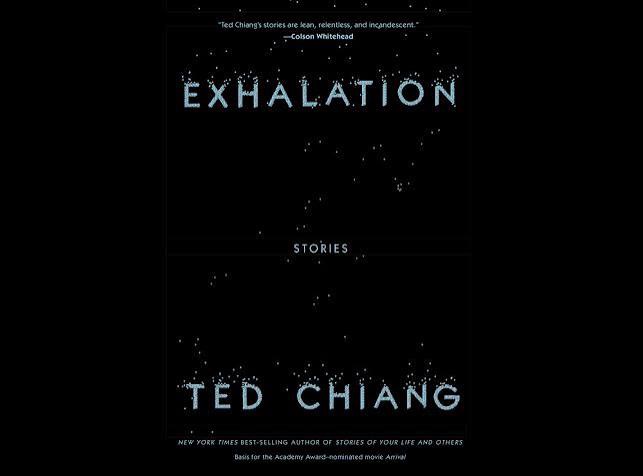
An unnamed mechanical being narrates Exhalation. They live in a world powered by compressed air. The narrator finds that mechanical clocks in different districts are running faster than individuals’ internal clocks. This has never happened before. Most dismiss these reports as coincidental. However, the narrator suspects something more serious. They decide to test their theory with a bold experiment. Using mirrors, lenses, and surgical tools, they disassemble their own brain.
After removing the plates from the back, top, and sides of their head, the narrator sees their brain. Even with a limited view, they think it is the most beautiful and complex engine they’ve ever seen.
“It was so far beyond any device man had constructed that it was incontrovertibly of divine origin.”
Typically, a scene like this evokes horror. A conscious being opens their own head to examine the mechanism of their thought. But the narrator doesn’t see the brain as grotesque. They view it as a beautiful engine, proof that they were deliberately created. For them, finding a machine inside their head doesn’t lessen life’s wonder; it confirms it. The brain may function mechanically, but its complexity feels miraculous.
The narrator’s calm tone changes the impact of the scene. They approach their brain like a scientist studying an unfamiliar machine. Since they don’t panic, the horror feels distant though not absent. The reader knows the experimenter is also the subject. The narrator lives both inside the brain and outside, observing it.
During the “auto-dissection,” the brain resembles “an explosion frozen an infinitesimal fraction of a second after a detonation.” This image conveys a sense of movement, at the same moment, it feels still. It represents both a machine and the shape of a thought in progress.
As the experiment continues, the narrator reflects on their body. The tools, like periscopes and lenses, feel like extensions of themselves. The line between their body and the equipment blurs. The narrator calls themselves “an everted person.” To evert means to turn something inside out. They have turned their consciousness outward to observe the structure that constructs it.
The experiment raises an interesting question. Where is the self now? Is it in the brain being studied, in the body outside it, or in the tools and mirrors they use? Their awareness seems to stretch across everything. The technology does more than let the narrator see their body; it influences how they see themselves.
The narrator discovers how consciousness works. Thoughts form when pressurised air flows through delicate gold leaf lattices. As air moves, the lattices open and close, creating patterns. The narrator learns that air is more than a life source; it’s the medium for their thoughts.
“All that we are is a pattern of flow.”
This could make consciousness seem less mysterious. Thought appears as a physical process created by air moving through machinery. Still, this discovery doesn’t reduce its wonder. A pattern of moving air can remember, question, fear, and become self-aware. The narrator is made of machinery, but that machinery can still ask how it came to think.
The narrator makes an important discovery. Air is not the true source of life. Life relies on differences in air pressure. Thought happens when air moves from high to low pressure. Without this difference, air cannot flow through the brain. If there’s no flow, there can be no thought. This also explains the mystery of the clocks. The turret clocks aren’t running faster; the brains of the mechanical beings are slowing down. Rising air pressure reduces the gap between the air in their brains and the air outside. Their thoughts slow down, but since everyone is affected, they don’t feel the change.
The clocks shows what their minds can’t. This is one of the story’s most disturbing ideas. If every mind changes at the same rate, no mind can notice the change from within. The inhabitants think the clocks are wrong. It’s simpler to doubt an external measurement than to admit that consciousness is slowing down.
The narrator learns their universe is a sealed chamber. Every breath adds compressed air to the atmosphere. As time passes, this air spreads throughout, equalising the pressure. Eventually, the pressure will become uniform everywhere. The air will still there, but it will stop moving. The end won’t come from air vanishing; it will come when the difference that allows air to flow is gone. The narrator calls this “perfect” or “absolute equilibrium.” At that point, air won’t move through the brain, so there will be no thought, memory, or consciousness. Stasis equals the death of their universe. This gives the story a unique take on life. Life needs movement, change, and difference, not just matter. Perfect balance may seem peaceful, but it means nothing can happen. Everything stays still, but no one will be alive to see it.
When the narrator reveals this discovery, panic spreads fast because of the threat of extinction. Once panic subsides, people search for ways to avoid extinction or extend their consciousness. However, this doesn’t solve the real problem. It delays the inevitable. As the narrator explains, life can’t continue unchanged. They can change their brains and gain more time, but they can’t fix the air pressure their world needs. Eventually, that difference will vanish, and all movement will stop.
Once the narrator realises their world can’t be saved, the investigation’s aim changes. Knowledge can’t prevent the end, but it can be preserved and shared. The narrator’s account becomes more personal. What starts as a scientific report turns into a confession, a warning, and a message for an unknown reader. They can’t ensure their kind will survive, but they can create chances for connection. They don’t know if the message will be found or if any being capable of reading it exists. But imagining such a reader allows part of their thought to reach beyond their own world. The narrator may not survive, but their ideas may continue within another consciousness.
Exhalation looks at life, death, and a civilisation’s wish to leave something behind. As Stephen Cave writes in Immortality, “All living things seek to perpetuate themselves into the future” (p. 12). I think the same applies here. The narrator can’t preserve their body, their people, or their world. But they can preserve a record of how they lived, what they found, and what it felt like to know their world would end.
When the narrator addresses an unknown reader, the story changes our position. We are no longer just observers. We become the beings to whom the account has been entrusted. By reading it, we give the narrator the witness they could only imagine.


 The Convergence Project
Leave a comment