Spoiler alert!
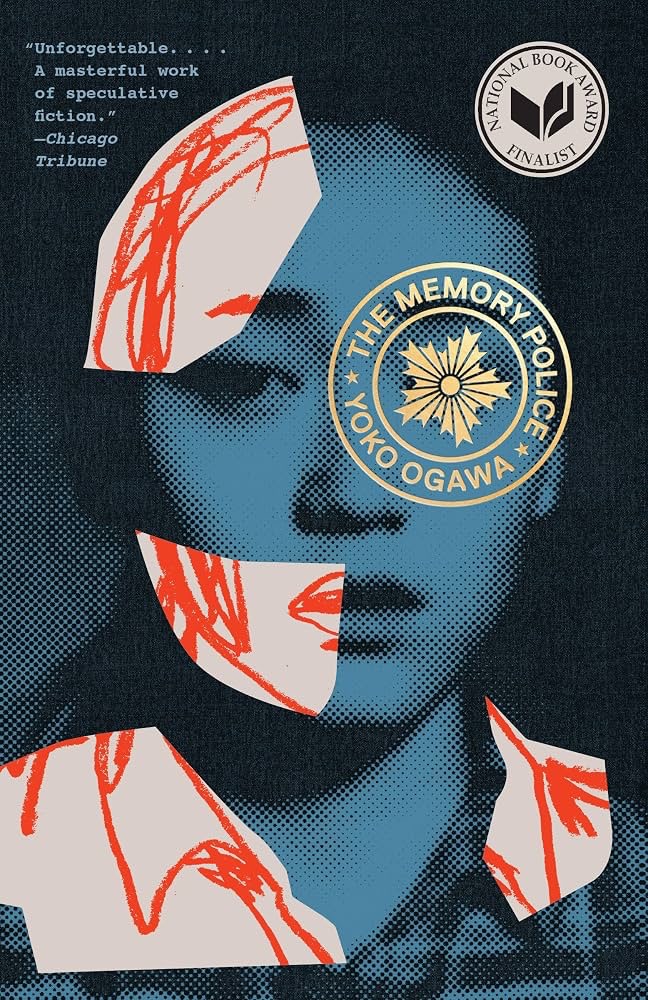
Some books welcome you in by explaining their worlds. Others, like Yoko Ogawa’s The Memory Police, sweep you off your feet. You only realise the world you’ve entered after you start falling. When I began reading, the ideas felt so strange. For the first twenty-five pages, I felt lost in an unanchored universe. It was thrilling. What I love most in fiction is this quality: everything feels familiar but with a twist. Nothing acts as it should.
The novel is set on an island. People work, eat, visit each other, fall ill, and grow old. Yet, things disappear. They are not misplaced or lost. They are disappeared. When this happens, most inhabitants lose not only the object but also their emotional ties to it. They forget what the object was and what it once meant. Birds disappear. Photographs disappear. Soon calendars, fruit, novels, and more follow. Ogawa doesn’t explain why. This withholding creates an immediate sense of menace. We don’t know who decides what disappears, why one thing goes and another stays, or whether anyone decides at all. The Memory Police enforce these disappearances, but they appear to be part of a bigger, stranger system. The absurdity of this premise makes the world even more unsettling. How can an entire category of things simply cease to matter? How can something that existed one moment feel meaningless the next? But this is exactly what happens, and the inhabitants mostly accept it.
Even when the Memory Police enter the narrator’s house, the novel feels dreamlike. They seem like another part of the island’s strange logic. Then, people start getting arrested. The narrator sees a group being taken away. She notices signs of how quickly the people left their homes. Their belongings are hastily packed, buttons are undone, and shoelaces are loose. Suddenly, everything changes. Until now, disappearance felt almost metaphysical. Things vanish from memory. Objects lose their meaning. The world quietly finds its way around the absence. Now, there are frightened people. There are weapons and trucks, and families are being taken away. The unreality of Ogawa’s world clashes with something disturbingly familiar. She never abandons the novel’s surreal quality when introducing violence: the impossible and the brutally familiar live side by side. One of the book’s strangest traits is that its horrors rarely announce themselves. They quietly enter ordinary life.
One of the questions the narrator poses is how the Memory Police spot those who can’t forget. These people look like everyone else. The narrator wonders why they can’t just pretend. Why not get rid of the vanished objects, say the right things, and act normally? Her editor, R, one of those who remembers, suggests pretending might be impossible. He says consciousness is just a small part of the mind. Something deeper reveals their true nature. Remembering isn’t just stored information in the brain. It lives within the person. It changes how someone sees an object, reacts to a word, or even fills a room. A part of them stays linked to what others have lost. The Memory Police aren’t just controlling possessions. They are also managing an internal state.
Later, the unnamed narrator, who is a novelist, asks another simple question: “And what will happen if words disappear?” That question changes the scale of the novel. Before this, the disappearances seem like events happening around her. Something vanishes, and she adapts. She loses objects, connections, and memories. But words are unique. For a novelist, words aren’t just tools. They shape how the world is understood and rebuilt.
Ogawa adds depth with a clever structural device. Some chapters start with scenes that seem part of the narrator’s life. In one scene, she climbs a narrow staircase that reminds her of a lighthouse from her childhood. After several pages, we realise we’ve entered the novel she is writing. A new world unfolds within another. The line between the narrator’s reality and her fiction becomes unclear in those moments. This tiny disruption invites readers to rethink their position. Later, when novels disappear, this structure gains a deep significance. The narrator doesn’t just lose books. She loses access to the part of herself that can write them.
One of the most beautiful disappearances is that of the roses. The narrator hears strange sounds outside and looks through the window. The river is now covered in colour. Red, white, and pink, slivers drift together on its surface. She goes downstairs, reaches into the water, and lifts her hands. Her palms are filled with rose petals. Ogawa’s view on disappearance is striking. It’s not visually empty; it’s quite the opposite. For a brief moment, disappearance feels abundant. The river is full, and vibrant colours surround her. The roses are at their most beautiful, even as their meaning fades. Soon, they will hold no meaning at all.
After R is hidden beneath the floor of the narrator’s late father’s office, she begins bringing him food and supplies. He remembers everything she has forgotten. At one point she asks him what it feels like to carry all of those vanished things inside himself. She imagines that such a heart must become unbearably crowded. His answer is beautiful. A heart, he suggests, has no fixed shape or limit. It can contain almost anything. Then only a few paragraphs later, the narrator begins imagining R’s heart not metaphorically. Instead, it is something physical, an organ she might hold in her hands that’s soft and slippery.
Ogawa moves again between the abstract and the physical. Memory may live in a limitless place, but R still has a body. And bodies have limits. R, who preserves memory, must stay hidden in a tiny room. As the narrator continues to visit him, she senses that he is changing. His body seems less defined. He grows pale and thin. There is a cruel symmetry here. The eternal heart suddenly becomes flesh. The townspeople are physically free, but their memories fade. R’s memories stay intact, but his body weakens as he hides away. One loses their inner world. The other loses his outer world.
When R asks the narrator whether she wants to recover her forgotten memories, the narrator struggles to answer. How can she desire something she no longer understands? This question is central to the novel’s themes. We often think of forgetting as something we can easily recognise. I have forgotten something. But Ogawa presents a deeper idea. What if the awareness of loss fades away too?
The narrator feels empty, describing herself as having no seeds inside her that could help her grow again. Her heart feels hollow, full of holes. If you know something is missing, you can look for it. But what if you forget there was ever anything to find? The absence then becomes invisible.
The novel becomes painful when novels vanish. People gather in a park and burn them. The scene feels ceremonial. Flames light up the crowd’s faces. Sparks fall around them. Piles of books disappear into the fire. The narrator watches, hoping to hold on to something until the end. A woman in the crowd can’t accept this. She screams and struggles. As the Memory Police take her away, she cries, “No one can erase the stories!” But the people nearby have already started forgetting what stories are. The loss of books is terrible, but worse follows. The narrator finds she can no longer read a novel properly. Soon, she can’t write one either. She sits before a blank page, waiting for a story to return, but words have moved just out of reach. She tries to grasp it, but there’s nothing there. Eventually, she types only the vowels—a, i, u, e, o—then erases them, hoping to restart what’s gone. It doesn’t work. She types them again and erases them again. The page starts to tear. The machinery of writing remains. The paper remains. The typewriter remains. The writer remains. But the invisible link between them is gone. Later, when R reads one of the narrator’s old stories aloud, she hears it like a fairy tale from a distant land. Her own imagination feels foreign to her.
Inevitably, parts of the body disappear. Seen alone, each loss blends into daily life. But together, they create a devastation. Forgetting turns into a skill. Like any skill, it gets easier with practice. Because things don’t just vanish into thin air. The inhabitants throw them away. They destroy them, release them into the river, or burn them. The disappearance starts within the person. The physical destruction follows. Most people feel no emotional link to what has vanished. So, destroying it seems reasonable. The Memory Police are still needed because some people remember. People like R are dangerous because they maintain connections. They know the present world isn’t the only one that has existed. They remember alternatives.
As the story unfolds, the island falls apart. Winter feels endless. Food is hard to find. An earthquake and tsunami hit the town. More items disappear. The people have less to build their lives with. There is the growing destruction, and there’s also how quickly each new reality feels normal. Once something is forgotten, the changed world starts to settle around its absence. Eventually, even the body disappears, until only the voice remains, and soon that too is gone. Yet the ending feels somewhat hopeful. People like R, who remember, hold onto what the island tried to erase. They can escape, find others who remember, and perhaps start anew, rebuilding a world from what’s left in memory.

 The Convergence Project
Leave a comment