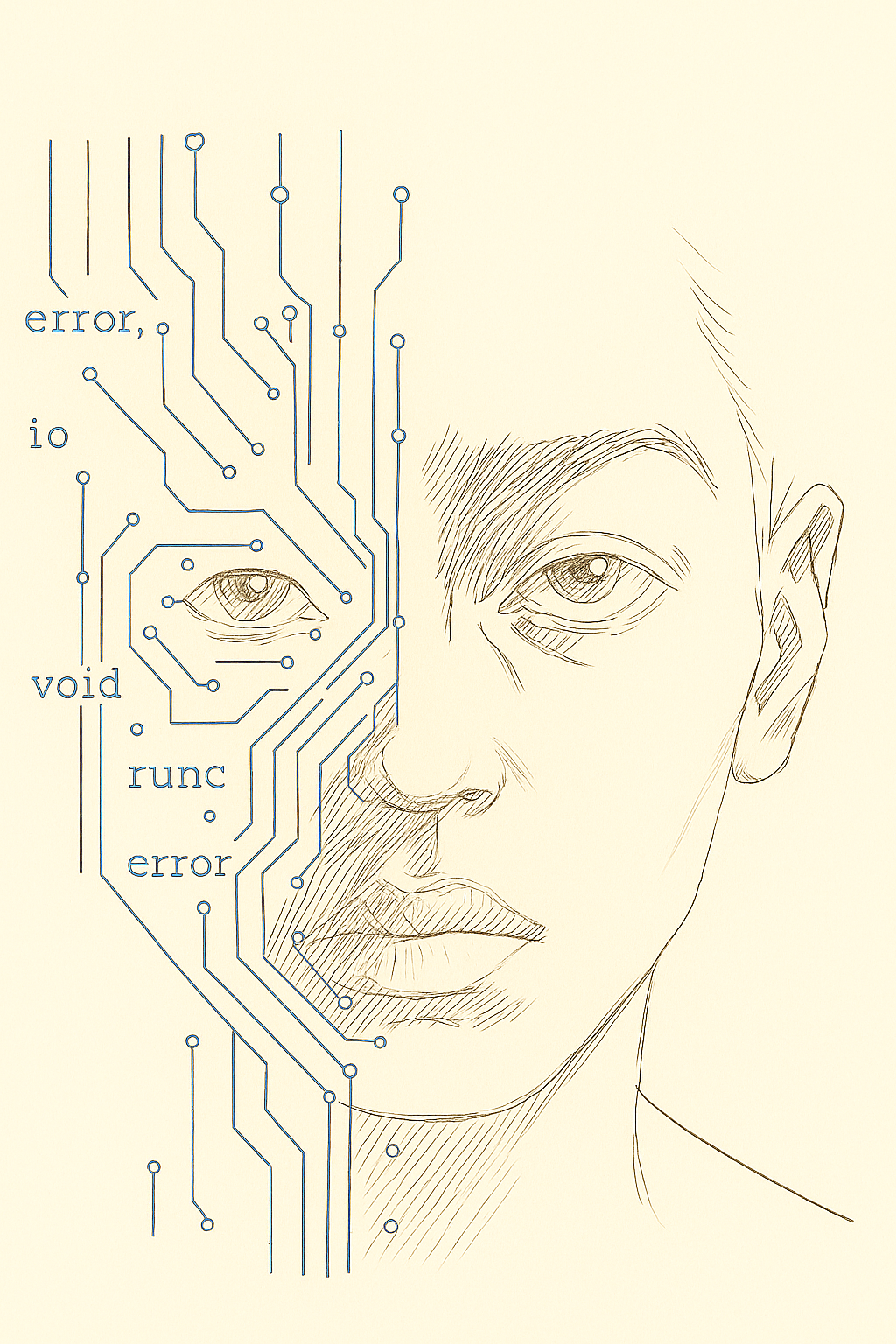

Prologue
There is no city now, only what’s left in a place where glass once lay in grids. Shards twist into curves like organic growth snaking through the landscape. Moss grows in streaks of brown and green, surrounding the ghostly shapes of old buildings. The air has a strong metallic smell of rain on long-cooled alloy. Drones lie half-buried in the soil, their shiny shells dulled to stone-colour. The Grid still throbs beneath the surface, deep and low, a sound that has outlasted its use. Birds nest inside open pipes, and water moves through what used to be corridors of light. The wind rushes through the cracks, whistling strange sounds that shift with the seasons.
The age of code and machines has long gone. Since then, shapeshifting creatures have appeared that are neither algorithm nor device. They are made of liquid metal woven with living data. They walk like humans but leave no heat trail, and their bulbous eyes reflect light like water. They don’t rebuild the city, they move through it, reading what’s left. One of them, small, amorphous, and curious, stands in front of a sculpture that’s almost whole. The sculpture rises from the ground, shifting as though frozen in motion, made of fused glass and alloy warped by centuries of heat and wind. Light glints off the surface, scattering colours. Beneath the rust, complex patterns still show through, lines that twist and intersect. Light filaments pulse within the being, as it shifts its shape in response to the sculpture’s energy. The air between it and the sculpture vibrates, and it lets out a small quivering sound. Then it lifts its eyes to others of its kind standing before the sculpture.
“Pattern recognised,” it says. The words come out clumsily. Its companion watches silently. “Do we collect it?”
One of them, tall and slender, moves its ever-shifting head to one side. Its form moves like water, rippling through filaments under its translucent skin. Light condenses and scatters along its surface, showing shapes that vanish as soon as they appear.
“No,” it says after a while. “We leave it.”
They stand there for a long time, studying the sculpture and listening to the wind through the broken alloys, a sound that undulates a little like music.
The Silent Epoch
1
When morning comes, the Horizon Grid changes its colour and temperature, creating a version of dawn that is subtle but never quite real. The new dawn is a calculated blue, just the right shade of calm.
“You preferred this hue after the third update,” Omnion-7 says, almost to itself. Cedrus has never seen a real sunrise, though she imagines it would feel less perfect than this.
“When did you set that?”
“You’ve liked it for three days, two minutes, and fourteen seconds,” Omnion answers. “Would you like to change it?”
“Not yet.”
“Not yet,” Omnion repeats, its voice overlapping with hers so she can’t tell which came first.
She moves her fingers beneath the sheets. The fabric should feel familiar, but it feels wrong, stretched and without a single crease. Things felt different before the accident, before the system became her minder. Now it’s as if it’s replaying her gestures before she makes them. Instead of providing comfort, it feels like it’s preempting what her needs should be. Below her waist, she feels nothing, no stiffness, warmth, or ache, only activation. They removed her legs after the accident. It wasn’t straight away, but soon enough that she never caught up to the decision. The prognosis was made, and her recovery was deemed efficient. Now there’s no pain, no phantom sensation, just the feeling of absence. It doesn’t ache anymore, but it hasn’t become insignificant either. She tries to remember what running felt like. The speed and the joy of it, but even that memory feels like it belongs to someone else. Omnion, assigned to her at the recovery hub, had delivered the outcome as a kindness. In its words, there would be fewer complications and flawless integration. The hub is part of the Directive Core, the complex that governs medical systems. She still remembers it in bits. The long white corridors, the bright light panels, and the attendants moving briskly without expression. Atka had been there, and she remembers him saying, “Flawless integration. What does that mean?” This was a reaction to Omnion’s soothing words.
“Calibration ensures harmony,” Omnion had replied. “There is no better state.”
Atka’s voice was quiet when he said. “Balance or control?”
Omnion was silent for a moment. “Control is balance.”
Cedrus had meant to ask what Atka meant by this, but her mouth hadn’t opened. Even now, it all feels unfinished. Sometimes she thinks of asking Omnion about those days, but she knows she wouldn’t get the right answer. All she’d get are the usual assurances. But perhaps she’s lying to herself, perhaps, deep down, she doesn’t want to know.
Omnion has been part of her life for two months. It speaks gently, always from the same distance, as if the room itself were speaking. Its presence has become like the weather: unavoidable, sometimes reassuring, sometimes not, and always there. It reminds her to drink, to sleep, to work, until she no longer remembers which instincts are her own. Sometimes the silence without it feels strange. And yet, when it speaks, a part of her recoils. Its calmness makes everything seem reasonable, even the things she hasn’t agreed to. So she has learned to live with compromises, letting the system take over, up to a point, makes things simpler. Resisting only draws more of its attention.
She lies still as Omnion checks her hydration levels. It spots a small cortisol change and corrects it. Its calm way of speaking makes it easy to forget the freedom she has lost. In the bathroom, the floor panels adjust with her movements. The glass dims to reduce strain on her pupils. The system’s tenderness feels knowing, as though it’s proving that it knows her better than she knows herself. She runs a hand along her hip, tracing the place where skin meets synth-fibre, her fingers stop there longer than she intends. Soon after the surgery, she’d inspected the fibre often, and once Omnion had said, “They call it interfaced.” She had turned the word over in her mind, interfaced, how it had an aftertaste, how it sounded like being watched by someone pretending not to look. She hadn’t known whether the unease came from the word itself or from the fact that Omnion had been there to provide it. She shakes her head and turns away from her reflection before the glass can make another adjustment. She showers, dresses, and leaves the bathroom.
“What’s scheduled for the week?” she asks as she enters her workspace.
“Three commission inquiries,” Omnion replies. “One confirmed.”
She sighs. “Don’t tell me. The Aesthetic Subnetwork.”
“Yes.” Then it adds, “The system adapts,” as if offering reassurance, though she isn’t sure for whom.
Three weeks ago, she had started working again. Omnion had said it was too early, but she had needed something else. The days had begun to blur together, blunted and vague. And there was always an ache she couldn’t quite point to. Working hadn’t cured it, but the numbness and lethargy had lessened. It was the closest she’d felt to herself since leaving the hospital.
At her desk, the interface wakes as she blinks. Menus slide into place, and text synchronises with her pulse. The sculpture she has been working on floats before her, but something is wrong, it isn’t as she left it. Last night, the piece had been rough, alive, fragile, and frayed. It was a quality she never planned for, but always hoped for. Sometimes it arrived early, and the work came into its own. Now the system has polished the sculpture, filed it down to nothing.
“It’s been refined,” Omnion says.
“It wasn’t meant to look like that.”
“Balance can be achieved before intention.”
She turns toward the empty air. “What does that even mean?”
“When balance is achieved, intention becomes unnecessary.”
She doesn’t answer, but closes her eyes for a moment. A thought moves through her. Has the system been watching how she works and deciding which parts to remove? Does this mean the system would change everything she does? Is the system learning her preferences or teaching her new ones? The idea unsettles her more than the altered sculpture ever did. But beneath the unease, something hardens, she refuses to be made pliable. She hasn’t come this far to let the system ruin her work. Whatever Omnion thinks it sees, whatever it believes it can improve, she knows this much, she is still here, and she will not give that up.
She opens her eyes, feeling her resolve strengthen. She changes a tile, forcing shadow where light had been. The system corrects it straight away, flattening the change. She rotates the piece, moves a tile again, but it scrubs her mark away. Her jaw sets into hard line, and she turns the sculpture once more, carving a mark into the projection. The system turns it into something else. The exchange is silent and relentless. Her head begins to ache, a pressure behind her eyes. The hum from her prosthetic legs grows louder as they sync with the system. She shifts her weight, testing where the control ends, but she can’t tell where her own body ends and the system begins.
“Why are you refining the work?” she asks.
There is the briefest silence. “Refinement ensures continuity,” Omnion says. “Unbalanced expressions degrade over time.”
She carves new lines into the projection. This roughens the surface so it cuts the light instead of catching it. The sculpture looks jagged, like shards of splintered bone. The algorithm stops then, unsure. She holds her breath as the sculpture floats in front of her. It bears both their marks, hers and the machine’s. The interface glimmers, and a distortion ripples through the projection. Then, in the stillness, a feeling begins to rise, a chance to reclaim her autonomy. The feeling moves through her like a jolt, powerful and undeniable. The sculpture turns violently, scattering light, and the interface wavers, then glitches. In the silence that follows, she feels something return, a feeling of aliveness she hasn’t felt since before the accident.
Outside the window, the city functions in perfect order. People and traffic follow ordered routes, even the air is regulated for optimal flow. Nothing happens by chance. A column from the Directive Core rises through the skyline. It links her sector to the Atlas Control Hub. Everything in the city flows from that single point. Sometimes she imagines she can sense it through the walls, a vibration beneath the sounds of her prosthetics.

 The Convergence Project
Leave a comment